



Reactive Power Parameters Explained: kVAR, kVARh, PF, and More
In electrical and energy management systems, terms such as kW, kVAR, kVA, kWh, kVARh, and kVAh are frequently used. These parameters represent different forms of power and energy, each serving a distinct purpose in system design, efficiency evaluation, and electricity billing.
Understanding their differences helps users:
- Accurately evaluate energy efficiency
- Diagnose power quality issues
- Optimize electrical systems
- Reduce unnecessary electricity costs
This article provides a clear, structured explanation of the most important electrical parameters used in modern power systems.
1. Basic Definitions of Electrical Parameters
| Parameter | Name | Description |
|---|---|---|
| kW | Active Power | The power actually consumed and converted into useful work such as lighting, heating, or mechanical output. |
| kWh | Active Energy | The accumulated active power over time. This is the unit commonly used for electricity billing. |
| kVAR | Reactive Power | Power required to establish electric and magnetic fields in inductive or capacitive loads. It does not perform useful work but is essential for operation. |
| kVARh | Reactive Energy | The accumulated reactive power over time. In many commercial and industrial regions, reactive energy is billed or penalized. |
| kVA | Apparent Power | The vector combination of active and reactive power, representing the total power supplied by the grid. |
| kVAh | Apparent Energy | The accumulated apparent power over time, used in some demand-based billing systems. |
2. Power Triangle: Relationship Between kW, kVAR, and kVA
Active power, reactive power, and apparent power form the well-known power triangle:
        |\
        | \
   kVAR |  \  kVA
        |   \
        |____\
          kW
Mathematical relationships:
- kW² + kVAR² = kVA²
- Power Factor (PF) = kW / kVA
A lower power factor indicates a higher proportion of reactive power, which can:
- Increase current in conductors
- Reduce system efficiency
- Increase transformer and cable losses
- Lead to higher electricity charges or penalties
3. Why Should You Monitor Reactive Power?
Residential Users
For most residential users, utilities focus mainly on:
- Active power (kW) — instantaneous consumption
- Active energy (kWh) — monthly billing basis
✅ Residential electricity bills typically do not include reactive power charges, so reactive power monitoring is usually not critical.
Industrial and Commercial Users
Industrial and commercial facilities often contain large inductive loads such as motors, HVAC systems, elevators, and transformers. As a result:
- Utilities may require a minimum power factor (commonly ≥ 0.9)
- Power factor penalties may apply when thresholds are violated
- In some regions, reactive energy (kVARh) is directly billed
- Apparent power (kVA) may determine base demand charges
✅ For these users, monitoring reactive power and power factor is essential for cost control and system optimization.
4. From Concept to Practice: Measuring Electrical Parameters
Once the concepts of active, reactive, and apparent power are clear, the next step is learning how to measure and analyze these parameters in real systems.
Modern smart energy meters can provide full visibility into:
- Active Power (kW) and Energy (kWh)
- Reactive Power (kVAR) and Energy (kVARh)
- Apparent Power (kVA)
- Power Factor (PF)
👉 Practical Guide: How to Measure Reactive Power (kVAR, kVARh, PF) with IAMMETER Smart Energy Meters
This guide explains how reactive power data can be accessed via cloud platforms, local web interfaces, and open communication protocols such as Modbus, MQTT, and HTTP APIs.
5. From Definitions to Real Monitoring
If you searched for kVAR, kVARh, or power factor, you may not only want a definition. You may be trying to solve a real monitoring problem.
| If you are trying to... | What matters most | Suggested next step |
|---|---|---|
| Understand kVARh or reactive energy on an electricity bill | Monthly kVARh, PF trend, low-PF duration | View reactive power monitoring case shows |
| Find when power factor drops | Hourly PF, kW and kVAR trend | Use IAMMETER as a lightweight PF analyzer |
| Verify whether power factor correction works | Before/after PF, kVARh and peak kVAR | See correction verification workflow |
| Learn how IAMMETER measures these values | Meter data, cloud view, local API, Modbus and MQTT | How to measure reactive power with IAMMETER |
| Send PF and kVARh data to EMS, BMS or a private dashboard | Modbus/TCP, MQTT and API data access | 3-phase reactive power with Modbus/MQTT |
IAMMETER does not correct power factor directly. It helps users monitor PF, kVAR and kVARh over time, identify when low PF happens, and verify whether correction measures are effective.
6. Typical Application Scenarios
- 🏭 Factory Energy Monitoring Improve power factor using capacitor banks and reduce grid losses
- 🏢 Commercial Building Energy Management Optimize transformer loading and avoid demand penalties
- ☀️ Solar PV and Grid Interaction Analysis Monitor inverter reactive output and grid compliance
- 🧰 Large Equipment Diagnostics Observe apparent power spikes during motor startup
7. Online Demo: Reactive Power & Power Factor Monitoring Dashboard
Try an online reactive power and PF monitoring dashboard:
https://iammeter.github.io/appstore/apps/mqtt-power-factor-analyzer/frontend/index.html
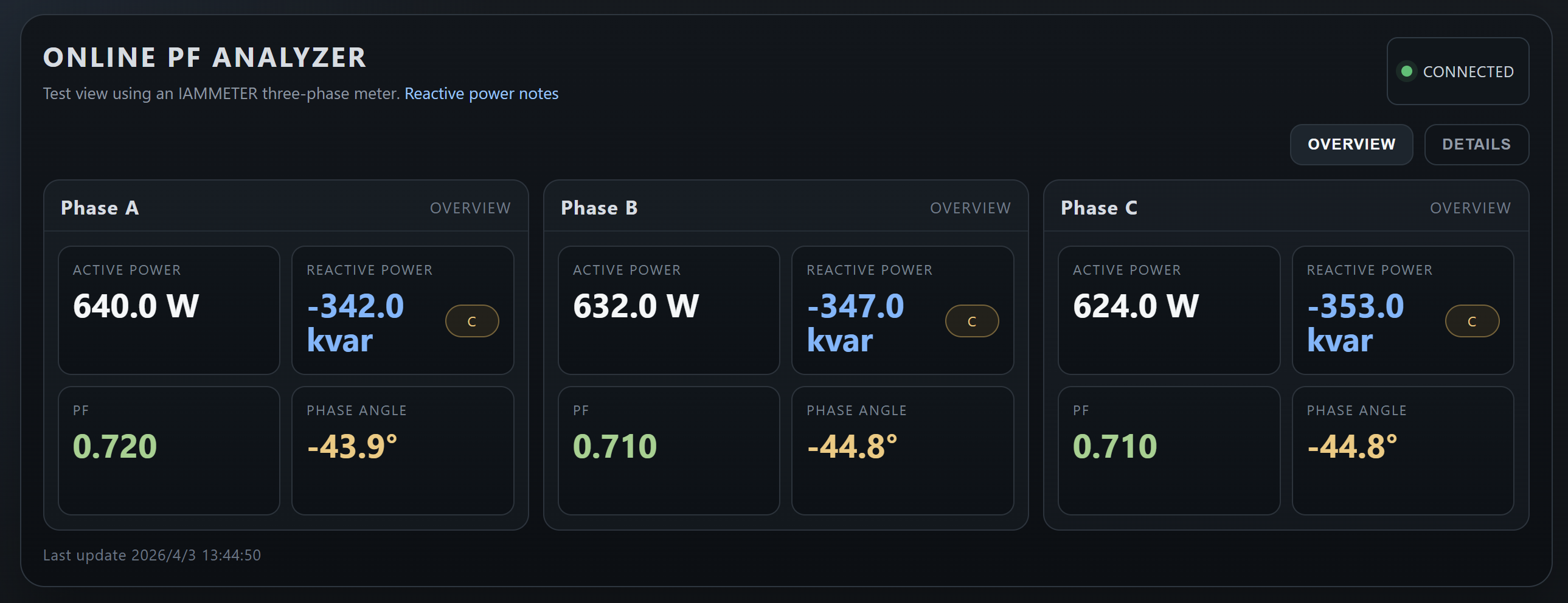
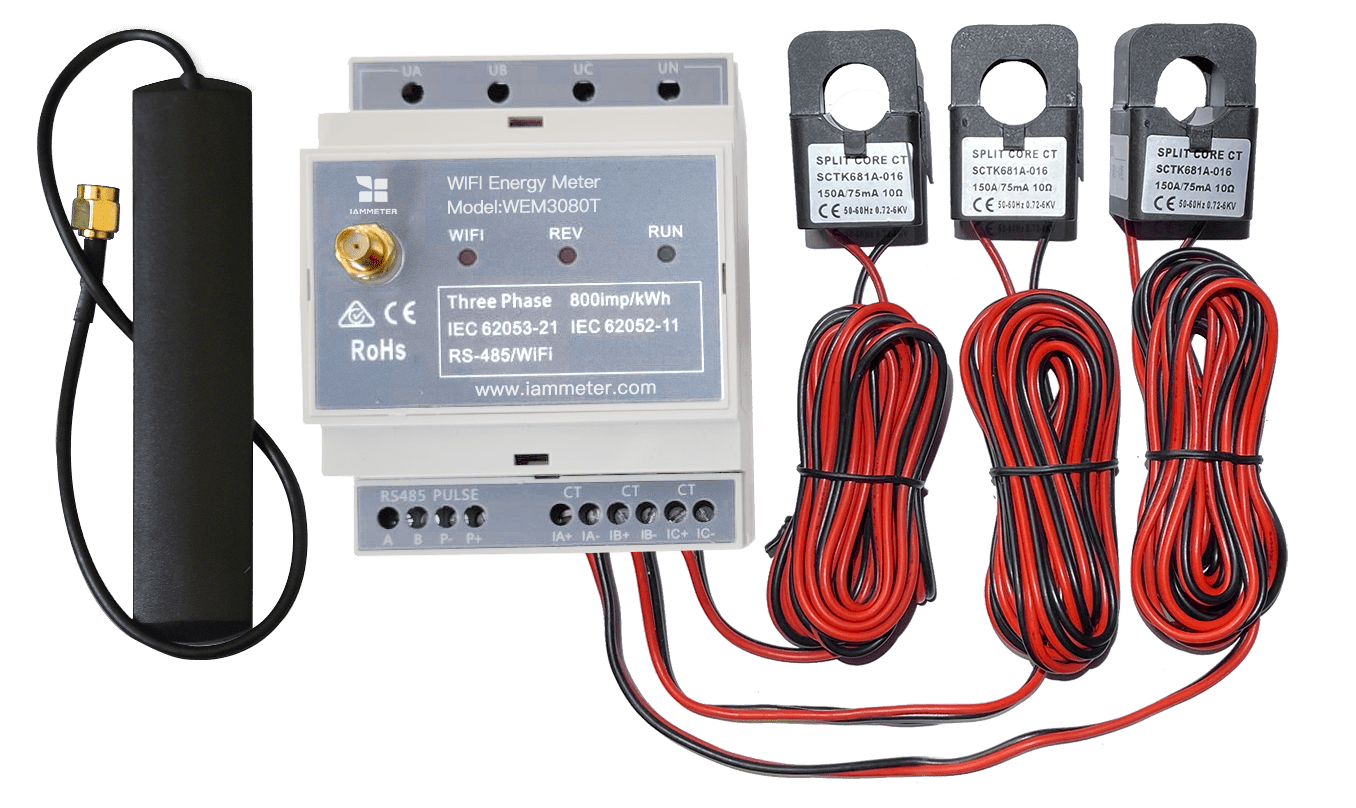
This online dashboard demonstrates real-time monitoring of reactive power and power factor (PF) using IAMMETER’s three-phase energy meter (WEM3080T). The page refreshes automatically every 6 seconds, allowing you to continuously observe power quality metrics.
The demo is useful if you want to see how PF, kVAR and kVARh can be visualized from meter data before building your own monitoring page.
This example also showcases IAMMETER’s MQTT data upload capability, where meter data is sent to a third-party server for visualization and analysis. Learn more about this feature here: 👉 Local API, Modbus/TCP and MQTT guide
If you prefer not to build your own server, you can use IAMMETER-Cloud, our ready-to-use cloud platform. A demo account is available with auto-login access: 👉 IAMMETER-Cloud demo
This demo provides a clear view of IAMMETER’s capabilities in power quality analysis (PF & reactive power) and cloud-based energy monitoring.
8. FAQ: Monitoring kVARh and Power Factor
Can I monitor kVARh over time?
Yes. IAMMETER meters can record reactive energy and power factor continuously, so users can review kVARh and PF trends by time period instead of only checking instant values.
How can I find when power factor drops?
By recording PF together with kW and kVAR, users can compare working hours, equipment cycles, motor startup periods, and other load changes. This is one of the main use cases of the lightweight reactive power and PF analyzer.
Can IAMMETER verify power factor correction?
IAMMETER does not perform power factor correction by itself. It can monitor PF, kVAR and kVARh before and after correction measures, helping users verify whether the correction result is visible in long-term data.
How can I read PF and kVARh data into my own system?
IAMMETER supports open interfaces such as local API, Modbus/TCP and MQTT. For technical integration, see 3-phase reactive power with Modbus/MQTT.
9. Conclusion
Modern energy management is not only about how many kWh are consumed, but also about:
- Whether the load structure is efficient
- How much reactive power is circulating
- Whether power factor meets utility requirements
- Whether unnecessary charges can be avoided
Understanding parameters such as kW, kVAR, kVA, and PF is the foundation for building efficient, reliable, and cost-effective electrical systems.
📅 Updated Record
2026-06-24 — Added practical monitoring paths for kVARh, PF drop diagnosis, correction verification, and Modbus/MQTT integration.
2026-04-03 — Added real-time power factor and reactive power monitoring dashboard (via MQTT from WEM3080T).